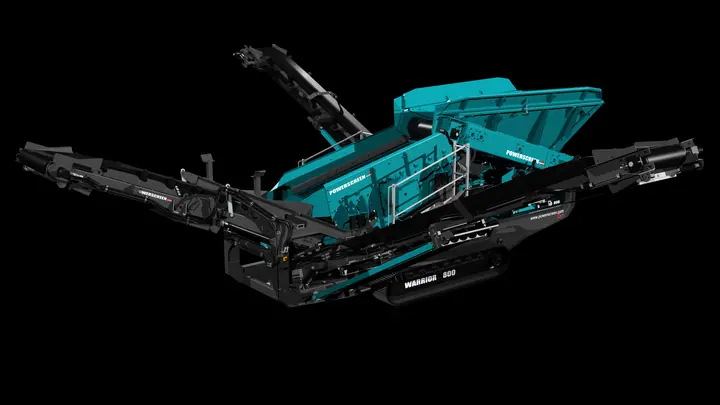
A screen sorts material by size. Feed drops from the hopper onto an inclined, vibrating screen box fitted with mesh, bars or punch plate. Anything smaller than the openings falls through to the deck below; anything larger rides across the top and off the end.
Two decks give three products in one pass; three decks give four. Each product leaves on its own conveyor and is stockpiled separately. Heavy-duty screens such as the Warrior can also scalp dirty feed before and after a crusher.
A jaw crusher is usually the first stage. Rock is fed into a V-shaped chamber between a fixed jaw and a swing jaw. Each stroke squeezes the rock until it breaks, and the pieces drop lower in the chamber until they are small enough to leave through the gap at the bottom.
The width of that gap sets the product size. Jaw plants take large quarry rock and demolition concrete and turn it into a feed that secondary crushers and screens can handle.
An impact crusher breaks rock by hitting it. A fast-spinning rotor fitted with blow bars strikes the feed and throws it against aprons. The rock breaks on impact, and adjusting the apron gap changes the size of the product.
Impactors give a well-shaped product and suit softer rock and recycling work such as concrete and asphalt. Models with an on-board screen return oversize to the crusher and make a finished product in a single pass.
A cone crusher takes rock that has already been through a primary crusher. A mantle gyrates inside a fixed concave liner. As the gap on one side closes, rock is crushed between the two; as it opens, the pieces fall further down until they pass out of the bottom.
Cones are used for secondary and tertiary crushing where a consistent, finer product is needed from hard, abrasive stone.
A wash plant uses water to clean aggregate. Spray bars rinse the material as it travels over a screen, carrying clay, silt and fine dust away with the water. The clean stone is sized and stockpiled, and the sand is recovered and dewatered.
Washing lets a pit sell clean, specified sand and aggregate from material that would otherwise be too dirty.
A stockpiling conveyor carries finished material up an inclined belt and drops it at the head drum to build a pile. Stacking with a conveyor instead of a loader keeps the product moving and reduces double handling.
Tracked and wheeled conveyors can be moved as the pile grows or as the job changes.